
Working emergently brings people alive
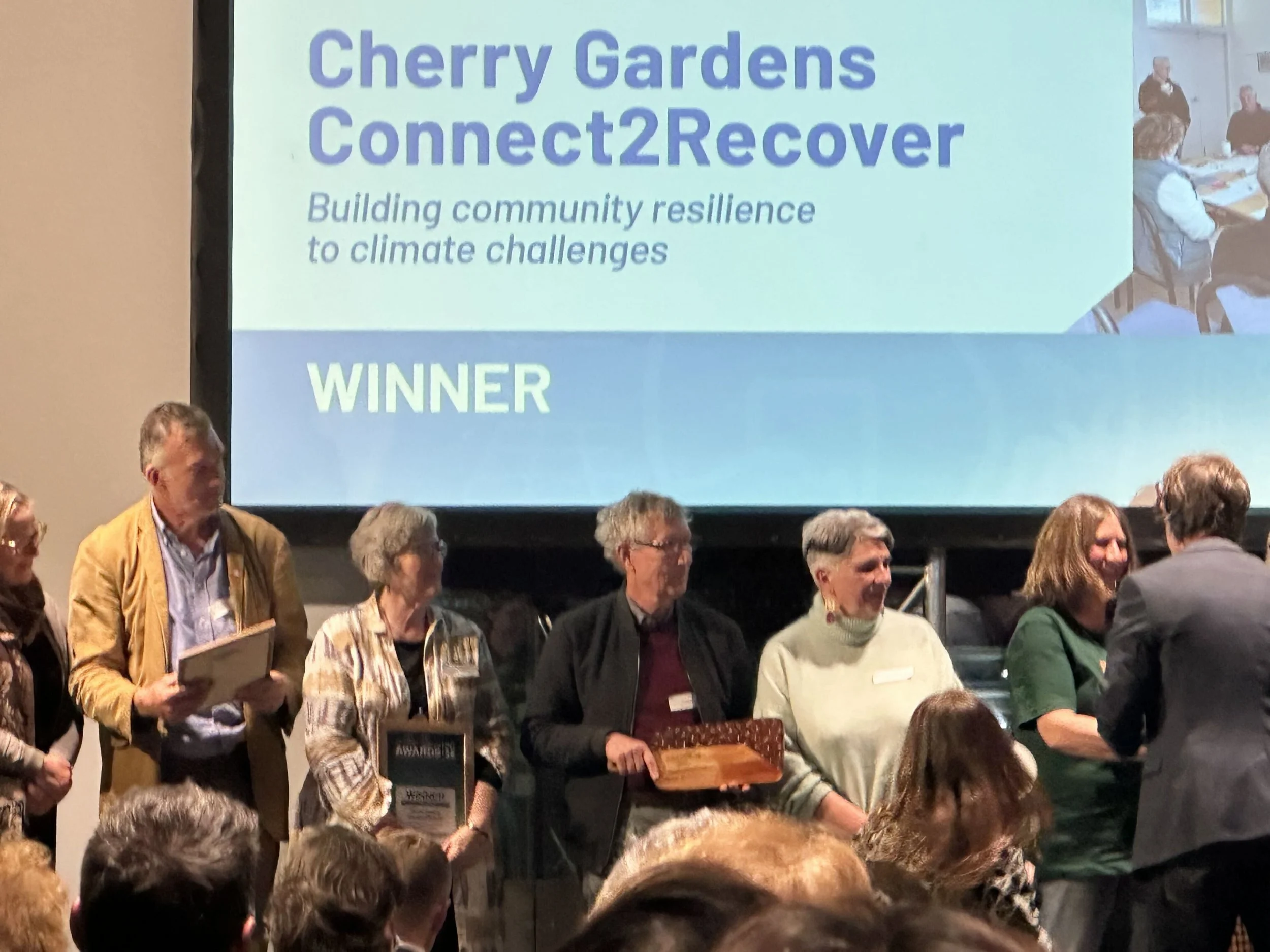
Cherry Gardens Connect2Recover receives the 2026 South Australian Climate Leaders Award
When the Work Brings Us Alive
Last week, Cherry Gardens Connect2Recover (of which I am a part) won the 2026 South Australian Climate Leaders Award, presented by the Premier’s Climate Change Council.
We are a community team with few resources beyond our care for the community, the time we can contribute and the different talents we bring. In 24 months, we have grown from six volunteers to a dozen, developed a practical community website and begun building resilience across four local hubs. We step forward at different moments. Nobody is controlling us, and nobody is paying us to be there.
Amongst other, more polished and professional organisations and research teams, the energy of our group seemed rather raw. But it also felt authentic. There was laughter, some nerves, and a real sense of excitement about doing something we genuinely believed mattered.
That energy tells us something important about how people work.
Exhaustion is trying to tell us something
Across sustainability, health and community services, I meet teams working incredibly hard on problems that seem to grow as they work on them.
People are endlessly tired. They are running on adrenaline, pushing towards predetermined goals even when their plans are producing little movement. They are implementing recommendations that make sense in theory but do not translate into the detail of everyday practice or the habits people rely upon to do that work.
We have a couple of options in our approach:
We can treat this tiredness as a personal problem and prescribe resilience training, better time management or another wellbeing initiative. Meanwhile, organisations absorb the operational consequences through presenteeism and a lack of change when it has never been needed more (does this sound familiar?).
Or we can become curious about it.
What if exhaustion is not a sign of change fatigue, but rather depletion caused by the way we work? What if it is telling us that the way we have structured the work is poorly matched to the challenge?
Wicked and complex challenges cannot be solved simply by working harder on a static plan because we do not know what the solution is. Wicked problems, by definition, have no solution. But we can make progress. We can make tomorrow better than today in some way, and to do that we need to learn together. These challenges involve uncertainty, interdependence and people with different perspectives, interests and experiences. The problem shifts as we engage with it.
When we treat adaptive work as if it were technical, people become confused or cynical – both deplete energy.
First know what kind of problem you have
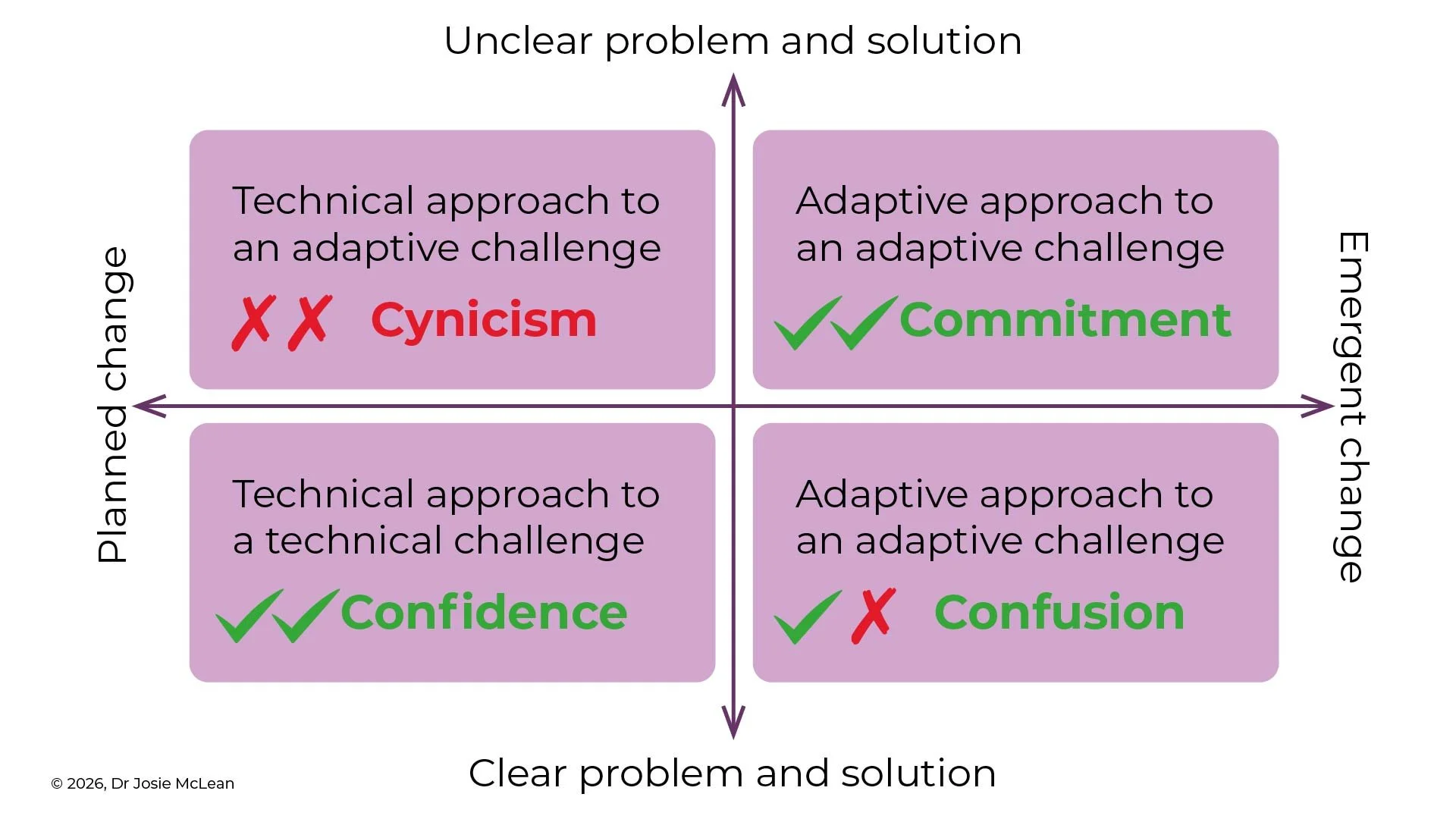
There is an important boundary here. Emergent practice should not become another blanket methodology.
This simple diagnostic can help.
If the problem is clear and a proven solution exists, it is probably technical. Use your authority or seek an expert to advise, then support people to implement the answer.
If people disagree about the problem, values and relationships are involved, or the situation changes as you act, the work is adaptive. It requires shared learning.
The challenges facing organisations today are becoming increasingly adaptive, such as climate adaptation, health reform, social disadvantage, and AI. These challenges require us to ask not just how something can be done, but why we are doing it and what we might disturb in the process.
Let’s look at AI as an example.
Consider an organisation that looks at all the tasks that AI can do, and adopts the perspective of, “if AI can produce X deliverable, we no longer need the person currently doing that task”. What may promise a short-term improvement in margins creates a longer-term capability erosion through the loss of judgement, client trust, and organisational learning.
People contribute more to an organisation than outputs and KPIs. Simply replacing output generation overlooks the nuance, judgement, and possibility of innovation unique to real people and the relationships between them.
Progress and uncertainty can coexist
Connect2Recover began as a group of six volunteers and has grown to a dozen over two years. That growth happened without funding or formal direction. And it happened despite several original members saying clearly “I’m only in this for 12 months – then I’m leaving”. People continue to step forward because the work is meaningful and rewarding. Early on, the group often felt blocked. We did not yet understand the problem we were trying to address.
One member, a mature ex-school teacher, said quite specifically, “I don’t have anything to contribute to this.”
Rather than assigning roles from the top down, we kept exploring the challenge together and created opportunities for people to contribute through their own ideas and strengths.
Over time, our teacher realised disaster recovery was not solely a technical field requiring specialist credentials. It was also about people, words, relationships and connection. She began writing articles for the local newspaper and became a driving force behind award nominations, including the one that led to last week’s win.
She came alive because she could see that her strengths and experience belonged in the work.
Others contributed connections within their networks, technical expertise about equipment, and past work experience ranging from emergency departments to libraries. Some spent time talking with people from other communities, while others developed a practical website through which community members can identify what they need and offer solutions. I contributed my facilitation skills and understanding of how to approach the work from a complexity perspective, without needing to teach it to everyone. We all have a perspective because we are all part of our community. That tangible progress mattered. It helped us feel that our efforts were producing something useful, even while the slower work of understanding our community continued.
Teresa Amabile’s research has long connected intrinsic motivation with creativity. Her work also points to the motivational power of meaningful progress. Research in positive psychology similarly suggests that using our strengths can support engagement, flow and persistence. This matters when the work is difficult because persistence fuelled by meaning feels very different from endurance fuelled by pressure.
Experiment instead of pretending to know
Emergent practice does not mean drifting without direction. It means creating safe-to-learn experiments that help us discover a more robust way forward.
For Connect2Recover, I have also developed two contrasting scenarios to help us experiment more quickly.
The first involved a widespread fire in Cherry Gardens as part of a larger Adelaide Hills event, including the loss of power from our local substation. The second was a short, sharp weekend tornado with only 30 minutes’ notice.
Testing our thinking against both scenarios clarified our role as a group, identified key roles we will need in practice, communication needs, and equipment priorities across four community hubs. The exercise moved us towards shared priorities without the coordination cost of debating a single imagined future. We identified the need for distributed backup power, potentially using different combinations of generators, renewables and batteries in different locations. We also identified UHF radios as a priority if both power and mobile networks failed.
If a tactic works across very different plausible futures, it is likely to be more robust than a plan built on the assumption that tomorrow will resemble yesterday.
Look for the sparkle
There is a difference between the energy of people who have been led to someone else’s answer and those who have discovered a way forward together.
You can see it: People participate. They offer ideas and share what they have been thinking. They take small risks. There is humour in the room and a sparkle in their eyes. There is also disagreement but the strength of relationships holds those different perspectives.
When an answer has simply been handed down, people may struggle to connect an abstract strategy with their daily work. Confusion and overwhelm follow. Priorities blur. Leaders may interpret the resulting hesitation as resistance, when people have actually been denied the adaptive journey through which conviction develops.
So perhaps one leadership indicator is simpler than we imagine.
Look for joy in the work.
Not constant happiness or the absence of difficulty, but the living energy that appears when people know their experience matters, can use their strengths and are trusted to learn their way forward.
Cherry Gardens Connect2Recover sits at an extreme end of the ways-of-working spectrum. We are volunteers, drawn together by care for our community rather than formal organisational roles. Yet I have seen similar energy emerge through organisational cultural transformation work with the City of Marion and HomeStart, and more recently through the SHINE case studies. In those settings, people developed a stronger shared language, connected organisational purpose with everyday decisions and became more willing to take responsibility for practical change. When people can connect their strengths and everyday work to a shared organisational purpose, they gain a stronger sense of agency, contribution and meaning. They, too, can be enlivened by their work.
Cherry Gardens Connect2Recover, like the Climate Coaching Alliance I co-founded, is a living example of work organised through living-systems principles. In practice, that means distributed rather than centralised capacity, cycles of action and reflection, and contribution based on what people can bring rather than the confines of formal roles. People contribute differently at different times. Action and reflection coexist.
The work remains challenging. Yet it need not steadily consume the people doing it.
When the way we work is better matched to the complexity we face, people do more than implement change. Change takes shape through them.
If you are leading adaptive work, choose one initiative and redesign the next step as a safe-to-learn experiment with your people, so you learn alongside them. Then notice not only what you learn, but what happens to the energy of the people involved.
Where to from here
If any of this resonates, my book Purposeful Cultures: A Practical Self-Leadership Guide explores these ideas in more depth, weaving together systems thinking, positive psychology and the everyday practice of leading adaptive work. It is written for people who sense that the old playbook is not equal to the challenges we face, and who want a more human way to lead.
For teams ready to put these ideas into practice together, the Purposeful Cultures: Discovery Circles program brings the book to life through a series of small-group conversations, facilitated from within your own organisation. It is designed to build the shared language, self-awareness and collective capacity that adaptive work depends on, at a pace your people set themselves.
Both are invitations into the same idea: that culture shifts when people are trusted to think, learn and contribute together.